Who is this switch best for?
- Office LAN expansion
- CCTV and IP camera networks
- WiFi access point connectivity
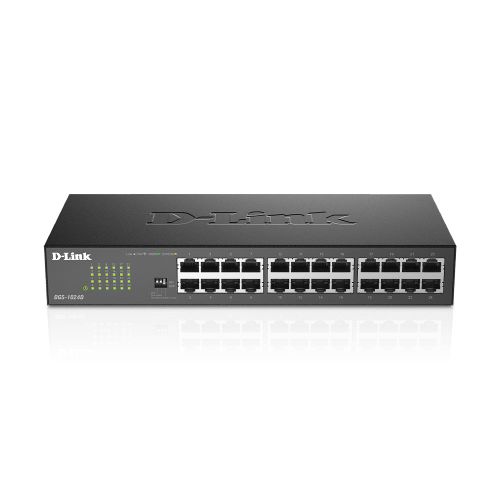
Works with standard Ethernet networking equipment including routers, computers, IP cameras, access points and servers. Confirm port, PoE and mounting requirements before purchase.
Check the product label or manufacturer datasheet for exact input voltage, power adapter and PoE requirements.
The D-Link DGS-1024D is an unmanaged Gigabit Ethernet switch for expanding wired networks in offices, schools, shops, computer labs and commercial premises. It connects computers, printers, network storage and separately powered equipment without requiring a controller or complex switch configuration.
With 24 Ethernet connections, it provides considerably more endpoint capacity than a typical router. It is a practical choice when the main requirement is reliable wired expansion rather than configurable network policies.
Request the current D-Link DGS-1024D price in Kenya from Network Switch Kenya, including confirmation of the hardware revision, mounting accessories and warranty coverage.
The DGS-1024D provides 24 Gigabit copper connections. One port normally links to the upstream router or another switch, leaving 23 ports for directly connected endpoints.
This is a non-PoE switch. Cameras, phones and access points require their own suitable power sources.
It is also distinct from the D-Link DES-1024D, which belongs to the Fast Ethernet category. Check the complete model name before ordering.
D-Link has released several hardware revisions. Dimensions, consumption and physical controls can differ, so the specification table identifies details from the referenced I2 datasheet.
Performance and physical details follow D-Link’s product information and I2 datasheet. Confirm the supplied revision before relying on revision-specific controls or dimensions. D-Link
A 24-port switch can bring a group of computers and shared resources together at one location.
This can simplify installations where several small switches would otherwise be scattered around the premises. Plan the cable routes and allow spare connections for future equipment.
Gigabit Connectivity for Local ResourcesGigabit connections are useful for file transfers, shared storage and applications involving suitably equipped devices.
Actual performance depends on the complete connection path. Storage speed, network adapters, cables and upstream equipment can all limit results.
The switch does not increase the speed supplied by an internet subscription.
Straightforward OperationBasic switching does not require an administrator account, browser login or controller.
Connected equipment still needs suitable settings. Printers require client configuration, cameras need activation and recording setup, and access points require wireless configuration.
If the installation needs configurable VLANs, detailed monitoring or access rules, select a managed switch.
Quiet InstallationThe referenced version operates without cooling fans, which is useful near working areas.
Ventilation remains necessary. Keep the enclosure clear of objects and avoid tightly enclosed placement where heat can accumulate.
Metal EnclosureThe metal housing suits a central equipment location. Appropriate placement and cable support help protect connectors from accidental strain.
Confirm mounting arrangements and accessories for the supplied revision before planning a rack installation.
Connect workstations, printers and local resources while the router provides internet gateway and firewall services.
For another unmanaged Gigabit option, compare the TP-Link TL-SG1024D at Orbitlink Solutions.
Schools and Computer LabsBring classroom or laboratory computers onto a wired network.
Assess the upstream connection and shared resources against the number of simultaneous users. If groups need separate network policies, an unmanaged switch alone does not provide the required configuration controls.
Retail and Administrative PremisesConnect appropriate POS equipment, computers and printers according to the business’s network plan.
Payment systems and other sensitive applications should follow the requirements of the complete network and service provider.
Shared Storage NetworksProvide connections between computers and local storage equipment.
Several users accessing one server may share its interface and storage capacity, even when every workstation connects at Gigabit speed.
Surveillance ConnectionsCarry traffic between separately powered cameras and recording equipment.
Check the recorder’s channel count, incoming bandwidth and storage independently. The switch does not power cameras or complete their recording configuration.
These examples illustrate physical connections rather than guaranteed application performance.
Traffic leaving the switch shares the upstream connection. Local communication between directly connected devices follows a different path from traffic crossing the router.
For another 24-port option, explore the TP-Link TL-SG1024 on Network Switch Kenya.
Do not assume every DGS-1024D has the same dimensions or controls.
For example, D-Link’s general product page lists a deeper enclosure than the referenced I2 datasheet. The appropriate specification is the one matching the unit being supplied. D-Link
Before purchase, confirm:
Read the product label and obtain the corresponding installation instructions.
Check that the quotation and packaging identify DGS-1024D, rather than the similarly named Fast Ethernet model.
Inspect the ports, enclosure and power connection.
2. Plan the CablingList every endpoint and reserve a port for the upstream connection.
Prepare tested Cat5e or Cat6 cables for Gigabit networking. Label permanent runs and document where each one terminates.
For ordinary copper Ethernet, plan within the standard 100-meter channel limit.
3. Choose the Installation LocationUse a stable surface or the supported mounting arrangement.
Keep the switch dry and ventilated. Leave space to inspect indicators and access cables, and avoid letting heavy cable bundles pull on the connectors.
Use only mounting hardware suitable for the supplied revision.
4. Review Physical ControlsIf the unit includes DIP switches, read their documented behavior before connecting production equipment.
A port-isolation setting can change which devices communicate directly. Do not enable it simply because the feature is present.
Establish basic operation before changing optional controls.
5. Connect PowerConnect the correct mains cable to a suitable supply. Check the power indicator.
If continuity during outages matters, size a UPS for the switch, router and other equipment needed to maintain service. Separately powered endpoints also need backup where required.
6. Connect the Upstream NetworkConnect a router LAN port to one switch port.
For an ordinary office installation, retain the existing modem or ONT connection to the router and place the switch on the LAN side.
Begin with one upstream cable. Do not create parallel paths between switches without an appropriate network design.
7. Add Endpoint DevicesConnect computers, printers, storage and other equipment gradually.
Check that each endpoint is powered and establishes an Ethernet link. Provide separate power to devices that need it.
If there is no link, reseat the connectors and try a known-good cable.
8. Check AddressingWhere the router supplies DHCP, ordinary clients can obtain network settings automatically.
For static-address equipment, verify unique addresses, the correct subnet, gateway and DNS settings.
The unmanaged switch itself does not require a management IP address for normal operation.
9. Test Local ResourcesPrint a test page, access shared storage and transfer a representative file.
For surveillance, test recording and playback as well as live viewing. Internet browsing alone does not verify the local installation.
10. Investigate Slow ConnectionsIf a computer reports 100Mbps instead of Gigabit, check endpoint capability and the complete cable path.
Inspect patch leads, wall outlets and terminations. Try another cable and port before replacing hardware.
An internet speed test measures more than the connection through the switch.
11. Test Simultaneous ActivityRun the applications expected during normal use.
This helps reveal limits in shared storage, servers or upstream connections that may not appear during a single-device test.
12. Label and DocumentRecord the upstream connection, endpoint ports and any physical-switch settings.
Keep the port map with the installation records so future troubleshooting does not depend on tracing every cable again.
If configurable network controls are required, review the UniFi Standard 24 or UniFi Pro 24. These use a different management approach from an unmanaged switch.
Another option is the MikroTik CRS326-24G-2S+RM at MikroTik Kenya. Compare configuration requirements and uplink arrangements against the project.
For powered endpoints, assess the UniFi Standard 24 PoE and UniFi Pro 24 PoE.
Orbitlink Solutions also lists the Ubiquiti USW-24-PoE and USW-Pro-24-PoE. Compare powered-port counts, standards and budgets rather than relying on total port count.
You can review the D-Link DGS-1024D at Tawa alongside Tawa’s separate 24-port Gigabit switch listing. Confirm the exact model and revision on each quotation.
Reisen SEO lists the D-Link DGS-1024D, TP-Link TL-SG1024 and TP-Link TL-SG1024D. Assess supplied accessories and installation requirements separately.
Fast Ethernet products serve a different speed requirement. Compare the TP-Link TL-SF1024D at Orbitlink Solutions and TL-SF1024 at Tawa accordingly.
Tawa also lists the D-Link DES-1024D unmanaged model and a separate DES-1024D desktop listing.
Additional comparisons include the DES-1024D at Reisen SEO and TP-Link TL-SF1024. Check the complete model name and supported speeds before purchasing.
Confirm the supplied mains cable, documentation and mounting accessories for the quoted hardware revision.
Specify Ethernet cables, patch panels, cabinets, UPS equipment and installation services separately unless expressly included. Verify product condition and warranty coverage before ordering.
No. Powered endpoints need a separate compatible source.
Does it require configuration?No switch configuration is required for basic operation. Some revisions have physical controls whose behavior should be checked.
How many endpoints can connect alongside a router?With one port used upstream, 23 remain available.
Is it the same as the DES-1024D?No. The DGS-1024D supports Gigabit Ethernet; the DES-1024D belongs to the Fast Ethernet category.
Can it create configurable VLANs?It does not offer the VLAN administration of a managed switch. Physical isolation controls on certain revisions are a different function.
Can local equipment work without internet?Yes, where devices and applications are correctly configured for local communication. Online services still require internet access.
Contact Network Switch Kenya for a quotation on the D-Link DGS-1024D 24-Port Gigabit Switch. Share your endpoint count, mounting needs and cable requirements, and confirm the hardware revision before purchase.
D-Link DGS-1024D 24-Port Gigabit Switch Price in Kenya is currently listed as available. Stock can change, so confirm availability before placing a large order.
The current listed price is KSh 15,500.00. Prices are generated from the product catalogue and may change when inventory is updated.
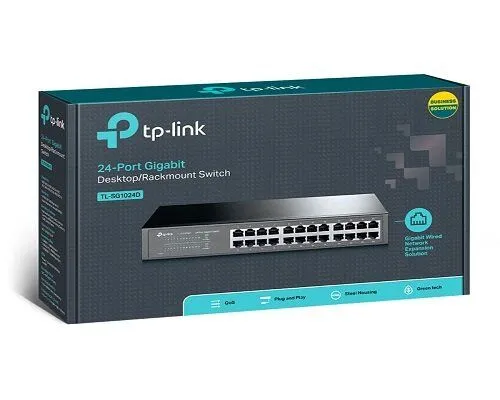
TP-Link
24-Port | Gigabit | Unmanaged
In Stock
TP-Link
24-Port | Gigabit | Unmanaged
In Stock
TP-Link
24-Port | Fast Ethernet | Unmanaged
In Stock
D-Link
8-Port | Gigabit | Unmanaged
In Stock